Prosthetic Covers, Housings & Specialized Accessories
External prosthetic components play an important role in protecting internal systems, improving
usability, and enhancing the overall experience of the prosthetic device. We engineer prosthetic
covers, protective housings, component enclosures, and specialized accessories that support the
functionality, durability, and personalization of advanced prosthetic systems.
Our design process begins by understanding the role of each external component within the
complete prosthetic system. We consider protection requirements, mechanical integration, user
preferences, environmental exposure, and interaction with other components. Through CAD
modeling, structural analysis, and design optimization, we develop concepts that combine practical
performance with an appropriate external design.
Although these components are positioned on the outside of the prosthetic system, they require
careful engineering to ensure they do not interfere with movement, accessibility, or overall
performance. Our designs focus on creating protective and functional elements that complement the
mechanical and electronic systems within the prosthesis.
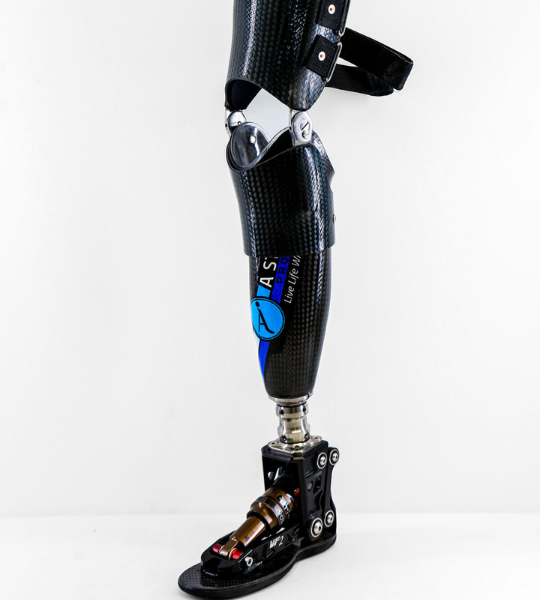
Key engineering considerations include:
• Component protection — Covers and housings must protect sensitive mechanical and
electronic elements from impacts, environmental exposure, and daily wear.
• Weight and structural efficiency — External components must provide protection without
adding unnecessary weight or reducing user comfort.
• Mechanical integration — Designs must fit precisely with internal components while
allowing access for adjustment, maintenance, and future upgrades.
• Ergonomic and aesthetic considerations — External designs should support user
confidence, comfort, and personalization while maintaining functional requirements.
• Specialized functionality — Accessories may be engineered for specific activities,
environments, or user needs while maintaining compatibility with the primary prosthetic
system.
One of the main engineering challenges is balancing protection with mobility. A housing that is too
rigid, heavy, or restrictive can negatively affect the performance of the prosthetic device, while
insufficient protection may expose critical components to damage. Engineers must carefully
evaluate materials, geometry, and attachment methods to achieve the right balance.
Another challenge is designing external components that integrate seamlessly with complex
prosthetic systems. Covers and accessories must accommodate mechanical movement, sensor
placement, charging requirements, and component adjustments without limiting functionality. This
requires close coordination between structural, mechanical, and electronic design considerations.
User experience is also an important part of the engineering process. Prosthetic devices are not only
functional tools but also personal devices used in everyday life. External components can contribute
to comfort, confidence, personalization, and acceptance of the technology.
Through engineering design, integration analysis, and iterative refinement, we develop prosthetic
covers, housings, and accessory concepts that enhance protection, usability, and overall system
performance while supporting the continued evolution of advanced prosthetic solutions.