Prosthetic Hands & Upper-Limb Components
Prosthetic hands and upper-limb components require precise engineering to replicate the complex
functions of the human arm and hand. We design prosthetic solutions that support grasping,
manipulation, positioning, and everyday interaction, while focusing on mechanical performance,
usability, reliability, and integration with advanced control technologies.
Our design process begins with understanding the functional requirements of the prosthetic system,
including intended activities, user needs, movement expectations, and interaction with the
surrounding environment. We analyze natural hand biomechanics, including finger movement, grip
forces, joint coordination, and dexterity, to develop engineering concepts that improve practical
functionality.
Using CAD design, mechanical analysis, and system-level engineering, we develop concepts for
hand structures, finger mechanisms, wrist components, and upper-limb interfaces. Our designs
consider the relationship between mechanical movement, user control, and ergonomic interaction to
create solutions that are both technically effective and intuitive to use.
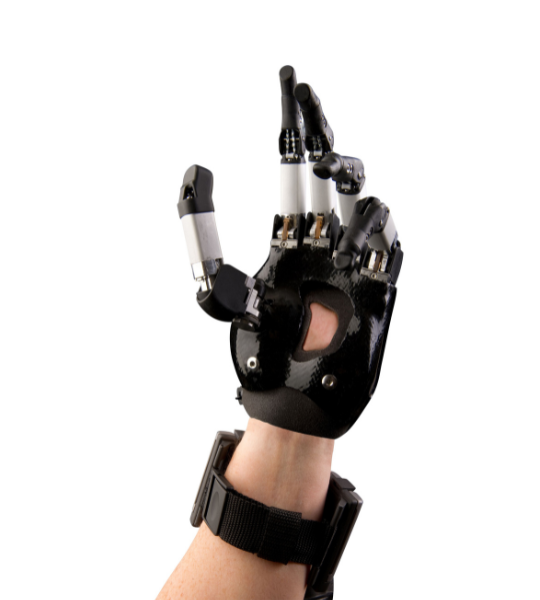
Key engineering considerations include:
• Grip functionality and dexterity — Prosthetic hands must support different types of
grasping, from precise finger movements to stronger power grips required for daily tasks.
• Mechanical complexity — Engineers must design compact mechanisms capable of
producing multiple movements while maintaining reliability and manageable system
complexity
• User control and interaction — Designs must consider how users communicate movement
intentions through mechanical, electronic, or sensor-based control methods.
• Size, weight, and ergonomics — Upper-limb devices must remain lightweight and
comfortable while providing sufficient strength and functionality.
• Component integration — Hand, wrist, socket, and control systems must work together
seamlessly to provide effective operation.
A major engineering challenge is reproducing the versatility of the human hand. The human hand
combines strength, precision, sensitivity, and adaptability through a highly complex arrangement of
bones, muscles, and joints. Prosthetic systems must achieve useful functionality through engineered
mechanisms that are often significantly more limited in size and complexity.
Another challenge is balancing capability with usability. Increasing the number of movements and
functions can improve performance but may also increase system complexity, weight, and user
learning requirements. Engineers must carefully evaluate which features provide meaningful
benefits while maintaining reliability and ease of use.
Durability and maintenance are also important considerations because hand components experience
frequent movement, repeated loading, and interaction with different objects and environments.
Mechanical elements, connection points, and moving parts must be designed for long-term
performance and consistent operation.
Through biomechanical analysis, mechanical design, and technology integration, we develop
prosthetic hand and upper-limb concepts that improve functionality, adaptability, and user
interaction. Our engineering work supports the development of advanced prosthetic solutions that
enable greater independence and improved daily performance.